
Sending a deposit to a factory you have never visited is the moment most sourcing risk becomes real. Up to that point you have only exchanged messages, photos and a price list. Once the money leaves your account, getting it back from the other side of the world is slow, expensive and sometimes impossible. That is why it pays to verify a Chinese supplier properly before you commit, and the good news is that most of the checks are free and can be done from your desk in a few hours.
This guide sets out a practical verification routine for importers buying from mainland China, whether you are ordering your first sample run or moving a larger contract to a new factory. It covers the official company registry, how to tell a real manufacturer from a trading company, what to look for in bank details and contracts, and how to structure payment so that the deposit is the smallest possible risk. None of it requires a lawyer for a first check, although for large or long-term contracts professional help is worth the fee.
A word on tone before we start. Verification is not about distrust. Most Chinese suppliers are legitimate businesses that expect buyers to check them, and the good ones make it easy. A supplier who resists basic, reasonable checks is telling you something useful early, which is exactly the point of doing them.
Start With the Official Company Registry
Every company registered in mainland China carries an 18-character Unified Social Credit Code, introduced from October 2015 under national standard GB 32100-2015. It works as the company’s single identifier for registration and tax, and it is printed on the business licence next to the words 统一社会信用代码. Ask your supplier for a clear copy of the business licence early in the conversation. Any established company can send it in a minute.
You can then check that code against the National Enterprise Credit Information Publicity System, known as GSXT, which is operated by the State Administration for Market Regulation at gsxt.gov.cn. Searching by the code or by the company’s full Chinese name returns the registered name, status, legal representative, registered capital, establishment date, address and business scope. The site is in Chinese and sometimes asks you to solve a visual puzzle, but a browser translation tool is enough to read the key fields.
Three things deserve close attention. First, the status: active companies show terms such as 存续 or 在营, while 注销 means deregistered and 吊销 means the licence was revoked. Second, any record of administrative penalties or a listing for abnormal operations, which can point to unpaid obligations or a company that could not be reached at its registered address. Third, the match between the registry and the documents you were sent. The name, code and legal representative on the licence should be identical to the GSXT record, character for character.
It is also worth noting how long the company has existed. A firm registered three months ago is not automatically a problem, since new factories open all the time, but it should not claim twenty years of export experience. Mismatches between the story and the record are the most common early warning sign.
Factory or Trading Company? Read the Business Scope
Plenty of good suppliers are trading companies. They can consolidate products from several factories, handle export paperwork and speak better English than the workshop manager. The problem arises only when a trader presents itself as the manufacturer, because you lose visibility of who actually makes your goods, and the price usually carries an extra margin you did not know about.
The business scope on the licence and the GSXT record is the quickest way to tell. A manufacturer’s scope normally includes production or manufacturing terms such as 生产 or 制造 for the product category, while a pure trader’s scope tends to list sales, wholesale or import and export, such as 销售, 批发 or 货物进出口. Some companies hold both. If the scope only mentions sales and the supplier insists it owns a large factory, ask which legal entity runs the factory and check that one too.
Registered capital and the registered address add context. A company claiming a 20,000 square metre plant but registered in a small office tower is likely a sales office. That can be perfectly fine, as long as you know it and can see the production entity behind it. Our earlier article on why buyers go directly to a plush factory in China shows how this trade-off plays out in one product category.
A Note on Export Licences
Older sourcing guides tell buyers to ask for a supplier’s foreign trade operator registration or export licence. That advice is now out of date. China amended its Foreign Trade Law on 30 December 2022, removing the requirement for foreign trade operators to register before importing or exporting goods, and local commerce authorities stopped handling those registrations from that date according to the Ministry of Commerce.
In practice this means a supplier without that certificate is not doing anything wrong, and a supplier who waves an old certificate around is not proving very much. What still matters is customs registration for the entity that will appear on the export declaration and any product-specific licences or certifications your goods need, for example for food contact items, electrical products or children’s toys. Ask which company will be the exporter of record and make sure it matches the name on your contract and invoice.
Match the Bank Account to the Company
Payment fraud is the risk buyers underestimate most. The pattern is familiar: a legitimate supplier’s email is compromised, and partway through the deal a message arrives saying the bank account has changed. The new account belongs to someone else, the deposit disappears and both sides blame each other. A second pattern is simpler, where a supplier asks for payment to a personal account or to an unrelated company, often offshore, with a vague explanation about tax or speed.
The rule that prevents most of this is easy to apply. Pay only to a corporate account held in the exact registered name of the company you contracted with, and confirm any change of bank details by phone or video call using contact details you already had, never the ones in the email that announced the change. If the supplier needs payment to go to a related company, such as a Hong Kong trading arm, ask for that entity’s registration and have it named in the contract before you pay.
See the Factory, Even If You Cannot Travel
Photos on a website or marketplace listing prove very little, since they are easy to borrow. You want evidence that the address on the licence is a working site and that the production lines you were shown actually make your type of product. Visiting in person is ideal, and trade fairs make that easier, but it is not the only option.
A live video call where someone walks from the gate to the production floor, shows the company name at the entrance and points the camera at machines running your product is a reasonable first step. Ask them to show something you request on the spot, such as the date on a phone screen next to a work order, so you know it is live. For larger orders, an independent factory audit by an inspection company gives you a written report on capacity, quality systems, working conditions and the legal entity on site. The cost is usually modest compared with a single container of goods.
Marketplace badges can help but should not replace your own checks. Verified supplier programmes on large B2B platforms typically confirm that a company exists and was visited at some point, which is useful, yet the badge does not tell you whether that company will make your specific product to your standard.
Documents to Request and What They Tell You
The table below lists the documents most buyers request before a first order. Not every supplier will have every item, and that is fine, but each one gives you a specific thing to cross-check.
| Document | What to check | Red flag |
|---|---|---|
| Business licence | Name, 18-character code, legal representative, scope | Details differ from the GSXT record |
| GSXT registry record | Active status, establishment date, penalties | Deregistered, revoked or abnormal operation listing |
| Bank account details | Account name matches the contracting company | Personal account or unrelated offshore company |
| Product certificates | Issuer, product model, certificate number, validity | Certificate issued to a different company or product |
| Audit or inspection report | Inspection company, date, legal entity on site | Report older than a year or for another address |
| Proforma invoice | Seller name, product specs, terms, bank details | Seller name differs from the contract |
Product certificates deserve their own check. Test reports and certificates often name a specific model and the company that applied for them. A supplier sometimes forwards a certificate issued to its own raw material supplier or to a different factory. Most certification bodies let you confirm a certificate number online, and a quick search often resolves the question.
Samples, Specifications and the Contract
A sample proves the factory can make the product once. Your contract needs to make sure it does so again across thousands of units. Before paying a production deposit, approve a pre-production sample made with the same materials and process as the bulk order, keep one sealed sample yourself and ask the supplier to keep its twin. When quality is disputed later, two matching reference samples save a lot of argument.
Write the specification into the purchase contract rather than relying on chat messages. Materials, dimensions and tolerances, finish, packaging, labelling, inspection standard, delivery date and the consequence of delay all belong in the document. Many buyers who work in China regularly use a bilingual contract with a Chinese version, governed by Chinese law and naming a Chinese court or arbitration body, because that is what a Chinese court will most readily enforce. For product designs you want to protect, a manufacturing agreement that covers non-use, non-disclosure and non-circumvention, often called an NNN agreement, is more useful than a generic Western non-disclosure form. For large contracts, ask a lawyer who practises in China to review it.
The contract should be signed and stamped with the company’s official seal, which in China carries more legal weight than a signature. Check that the name on the seal matches the registered company name exactly.
Structure Payment to Limit What You Can Lose
Payment terms are the last and most powerful safeguard. A common arrangement for a first order is a deposit of around 30 percent to start production and the balance before shipment or against a copy of the bill of lading. The exact split is negotiable and depends on the product, order size and how much custom work the factory must do before it sees your balance. Our sister guides on factory topics, such as working with an OEM feed mixer manufacturer or a TP valve OEM factory in China, show how terms tend to differ for engineered products.
Tie the balance to something you can verify. The most common link is a pre-shipment inspection: an independent inspector checks a random sample of finished goods against your specification, and you release the balance only after the report is acceptable. For larger amounts or new relationships, a letter of credit or a platform escrow service shifts more risk away from you, although both add cost and paperwork. Whatever you choose, avoid paying 100 percent upfront to a supplier you have not verified, however attractive the discount.
Here is a simple pre-deposit routine you can run on every new supplier:
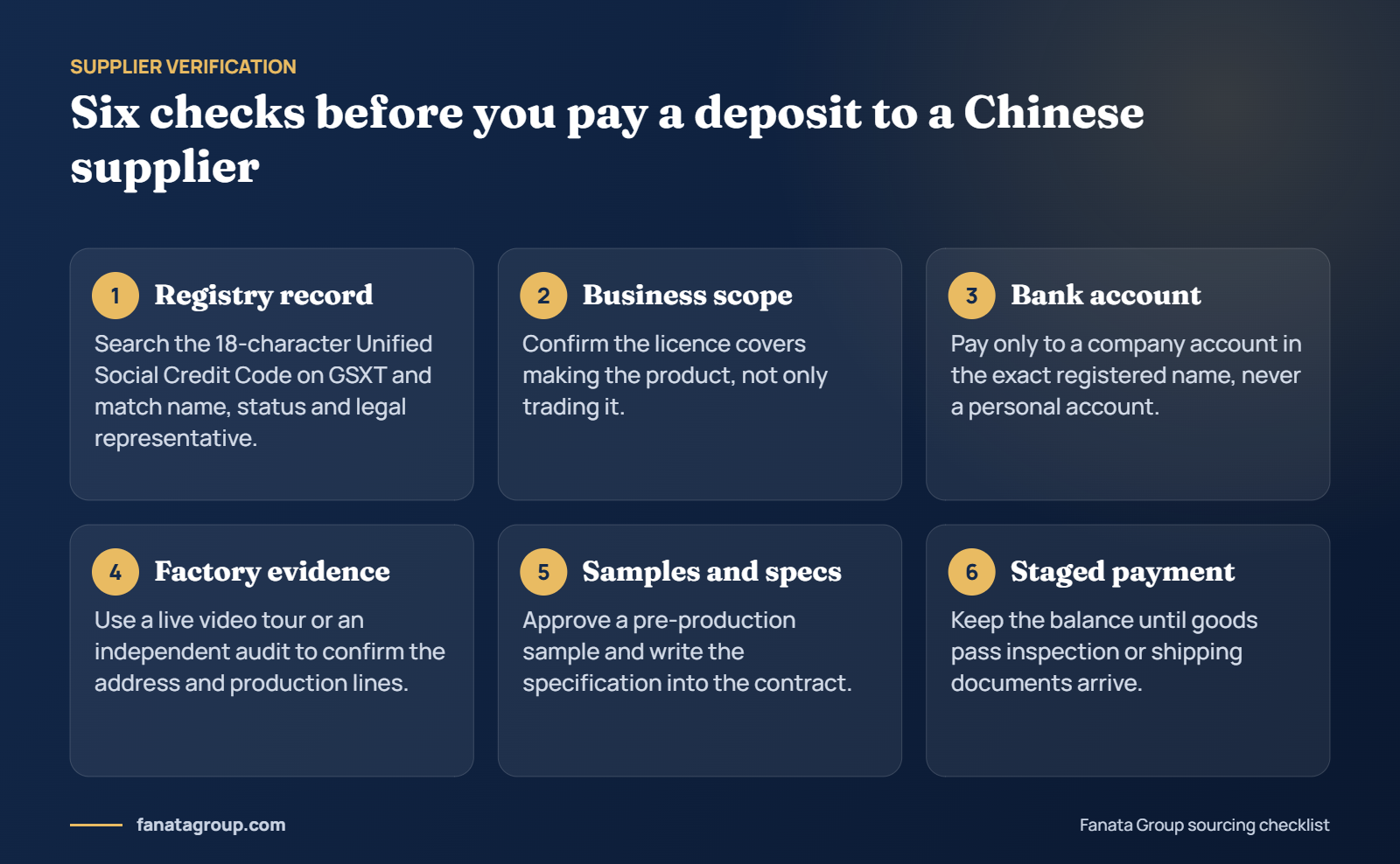
- Get the business licence and search the 18-character code on GSXT.
- Compare name, status, legal representative, address and scope with what the supplier told you.
- Decide whether you are dealing with the manufacturer or a trader, and identify the factory entity if it is a trader.
- Confirm the bank account is a corporate account in the contracting company’s exact name.
- Run a live video tour or book an independent audit for larger orders.
- Approve a pre-production sample and keep a sealed reference.
- Sign a contract with full specifications, stamped with the company seal.
- Agree staged payment tied to inspection or shipping documents.
Red Flags That Should Stop the Deal
Some warning signs are serious enough to pause until they are explained. A price far below every other quote for the same specification is the classic one, because it usually means cheaper materials, a different product or no intention to deliver. Pressure to pay quickly to secure a slot or a special offer is another, especially when combined with a request to skip samples.
Be equally wary when the supplier cannot or will not provide a business licence, when the company on the invoice is different from the one you negotiated with, or when bank details change by email. Inconsistent stories about factory size, staff numbers or export markets, and reluctance to show the production floor live, round out the list. None of these prove fraud by themselves, but each one deserves a clear answer before money moves.
If you buy components or finished goods in categories like heating controls or kitchenware, it can also help to compare suppliers who specialise in that field. Guides such as our overview of smart thermostats made in China, underfloor heating from China and wholesale cookware suppliers show what established manufacturers in those sectors typically offer.
Frequently Asked Questions
How can I check if a Chinese company is real?
Ask for the business licence and search its 18-character Unified Social Credit Code on the National Enterprise Credit Information Publicity System at gsxt.gov.cn, run by the State Administration for Market Regulation. The record shows the registered name, status, legal representative, address and business scope. Every detail should match the licence and the contract, and the status should show the company as active.
How do I know if a supplier is a factory or a trading company?
Read the business scope on the licence and the registry record. Manufacturers usually list production or manufacturing terms for the product category, while traders list sales, wholesale or import and export. A video tour of the production floor and an independent audit report confirm what the paperwork suggests. Trading companies can be good partners, as long as they are honest about the role they play.
Does a Chinese supplier need an export licence?
For most goods, no. China removed the foreign trade operator registration requirement when it amended the Foreign Trade Law on 30 December 2022. Companies still need customs registration to export, and some products need specific licences or certifications. Focus on which company will be the exporter of record and whether your product has the certificates required in your market.
What deposit is normal when ordering from China?
Many suppliers ask for a deposit of around 30 percent, with the balance paid before shipment or against shipping documents, though terms vary with product, order size and how much custom tooling is involved. Whatever the split, tie the balance to a pre-shipment inspection or a copy of the bill of lading, and avoid paying the full amount upfront to a supplier you have not verified.
What should I do if a supplier changes its bank details?
Treat it as a possible fraud attempt until proven otherwise. Do not reply to the email that announced the change. Call or video call your usual contact using details you already had and ask them to confirm the change in writing, signed and stamped. The new account should still be a corporate account in the contracting company’s exact registered name.
Conclusion
You can verify a Chinese supplier thoroughly without leaving your office. Check the 18-character code on GSXT, read the business scope to understand whether you are dealing with a factory or a trader, confirm that the bank account matches the company, look for live evidence of the production site, lock the specification into a stamped contract and structure payment so the balance depends on inspection. Each step takes little time, and together they remove most of the risk that comes with a first deposit. For more practical guides on factories, materials and supply chains, browse the Fanata Group topics page.
Reviewed by Fanata Group Editorial Team. Last updated November 28, 2026.