
Underfloor heating has a reputation for comfort, but many people who are thinking about installing it want to know one thing first: what will it cost to run? The honest answer is that underfloor heating running costs depend less on the pipes or mats under the floor and more on five other things: how much heat the room loses, what produces the heat, the temperature the system runs at, what covers the floor and how the system is controlled. Get those right and underfloor heating can be one of the cheaper ways to keep a space warm. Get them wrong and it can be surprisingly expensive.
This guide explains each factor in plain terms, shows how to estimate running costs for your own project and points out the common mistakes that push bills up. It covers both wet systems, which circulate warm water through pipes, and electric systems, which use heating cables or mats. Where we quote figures, they come from published sources such as the Energy Saving Trust and Which?, and they are there to show the scale of differences rather than to predict your bill.
If you are still deciding whether underfloor heating suits your building at all, our overview of underfloor heating pros and cons and the explainer on how underfloor heating works are good places to start.
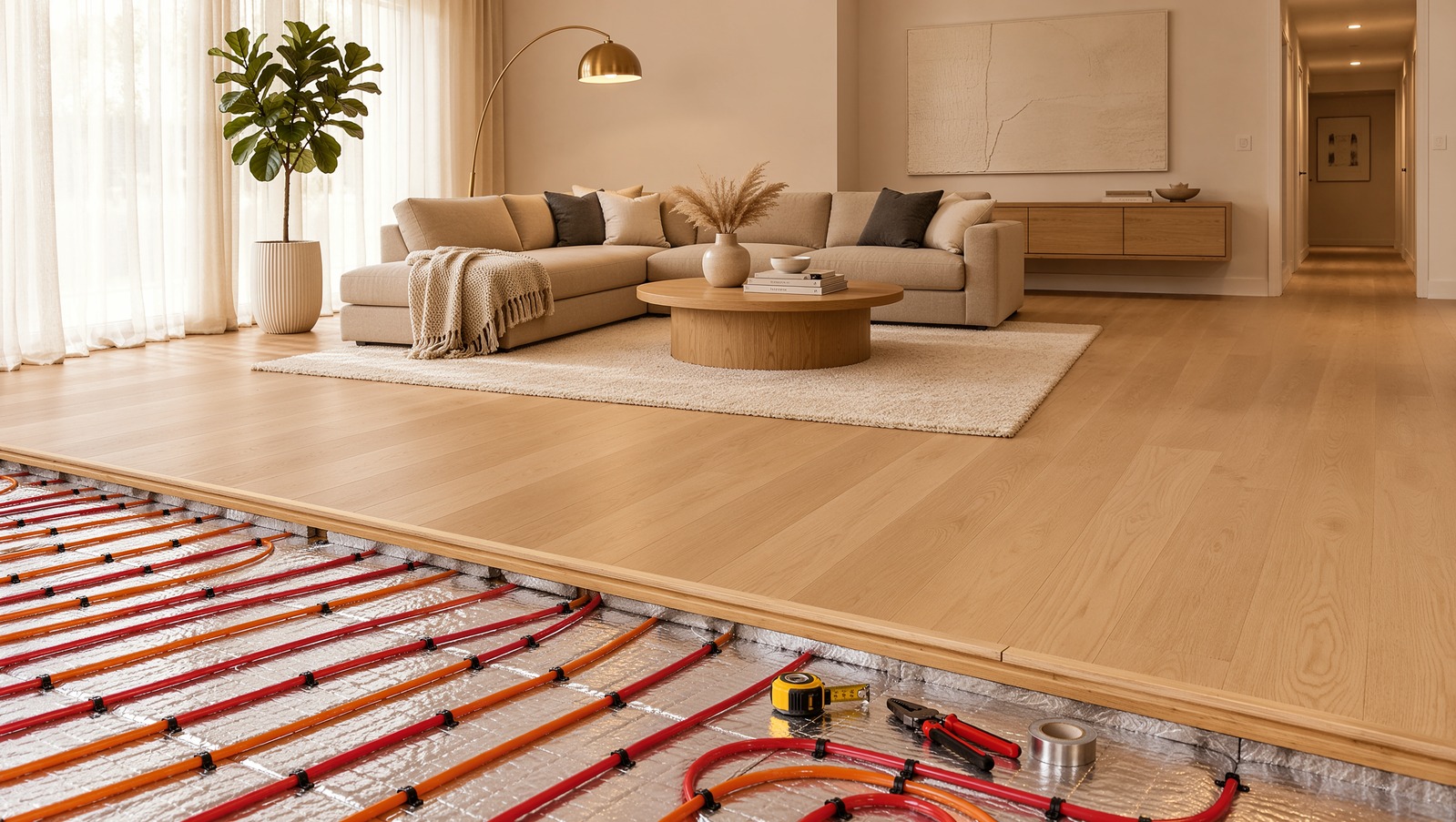
The Simple Formula Behind Running Costs
Every heating system, underfloor or not, follows the same basic arithmetic. First, the building needs a certain amount of heat over the season, measured in kilowatt hours. That figure is set by the size of the space, how well it is insulated, how airtight it is, the climate and the temperature you want indoors. Second, the heat source converts fuel or electricity into heat with a certain efficiency. Third, you pay a price for every unit of fuel or electricity used. Running cost is roughly heat demand divided by efficiency, multiplied by the unit price.
Underfloor heating does not reduce the heat a room needs. A badly insulated room loses the same heat whether it is warmed by a radiator or by the floor. What underfloor heating can change is the efficiency side of the equation, because it delivers heat over a large surface at a low temperature. That suits heat pumps and condensing boilers, which both work more efficiently when the water they produce is cooler.
A quick example shows why the heat source matters so much. Suppose a room needs 1,000 kWh of heat over a winter. An electric mat turns each kWh of electricity into roughly one kWh of heat, so it would use about 1,000 kWh. A heat pump running at a seasonal efficiency of three would deliver the same heat from about 333 kWh of electricity. These are illustrative numbers, not a forecast, but the ratio explains most of the difference in real bills.
Wet Versus Electric Underfloor Heating Running Costs
Electric underfloor heating is cheap and quick to install, thin enough to fit under most floor finishes and easy to retrofit into a single room. The trade-off comes on the energy bill. Because the cables turn electricity directly into heat, there is no efficiency gain, and electricity usually costs more per kWh than gas. Grand Designs notes that the Energy Saving Trust does not recommend electric underfloor heating for large areas for this reason.
Wet systems cost more to install, need a manifold, pump and pipework and add height to the floor build-up. In return they can be connected to any wet heat source, including gas or oil boilers, biomass boilers and heat pumps. Over a whole house and many years, that flexibility is what makes wet systems cheaper to run. Our comparison of electric or water underfloor heating looks at the installation side in more detail.
A sensible pattern in many projects is to use electric mats in small rooms that are heated occasionally, such as a bathroom floor that only needs to take the chill off in the morning, and a wet system everywhere else.
Flow Temperature and the Heat Source
Radiators have a small surface area, so they need hot water to put enough heat into a room. Industry sources commonly quote radiator water temperatures of around 60 to 80°C. A wet underfloor system covers most of the floor, so it can do the same job with much cooler water, usually in the region of 35 to 45°C according to guides from Grand Designs and Screwfix. The Energy Saving Trust highlights this lower flow temperature as the main reason underfloor heating can cut bills, because boilers and heat pumps both work better at low temperatures.
For condensing boilers, low return temperatures allow the boiler to condense water vapour from the flue gases and recover extra heat. For heat pumps the effect is larger, because the efficiency of a heat pump drops as the gap between the outdoor temperature and the water temperature grows. Running a heat pump into a well designed underfloor system at a low flow temperature is one of the most efficient ways to heat a building, which is why the two are so often installed together. If you are pairing underfloor heating with a boiler, our article on underfloor heating with a boiler covers the practical connection details.
The catch is that low flow temperatures only work if the system is designed for them. Pipe spacing, pipe length per circuit and the heat output needed per square metre all have to be calculated for the room. A system designed for a 50°C flow will not keep a cold room warm at 35°C, and the temptation then is to turn the temperature up, which erodes the efficiency gain.
Insulation and Heat Loss
Insulation is the factor people underestimate most. Heat flows downwards as well as upwards, so a system laid on an uninsulated slab spends part of its energy warming the ground. Insulation boards beneath the pipes or mats direct heat into the room and shorten the time it takes the floor to warm up, a point Screwfix makes in its cost guide.
The rest of the building matters just as much. Which? warns that in an older home with solid walls, no loft insulation or single glazing, underfloor heating may not be able to heat a room on its own. In that situation the floor has to run warmer and longer, running costs rise and comfort suffers. Improving the building fabric first, even with simple measures like draught-proofing and loft insulation, often does more for the bill than any heating upgrade. Our guide to insulation materials explains the common options.
Floor Coverings and Thermal Resistance
Everything between the pipes and the room slows heat down. Stone and ceramic tiles conduct heat well, which makes them the classic partner for underfloor heating. Engineered wood and laminate work too, as long as the manufacturer approves them for heated floors. Carpet and underlay add the most resistance.
The Energy Saving Trust advises checking the tog rating of carpet plus underlay, citing a recommendation from Home Building & Renovating that the combined rating should be 2.5 tog or lower. Above that, the system has to run warmer to push the same heat through, which costs more and can leave the room feeling sluggish. Rugs placed later have the same effect locally, so it is worth planning furniture and rugs before the floor goes down.
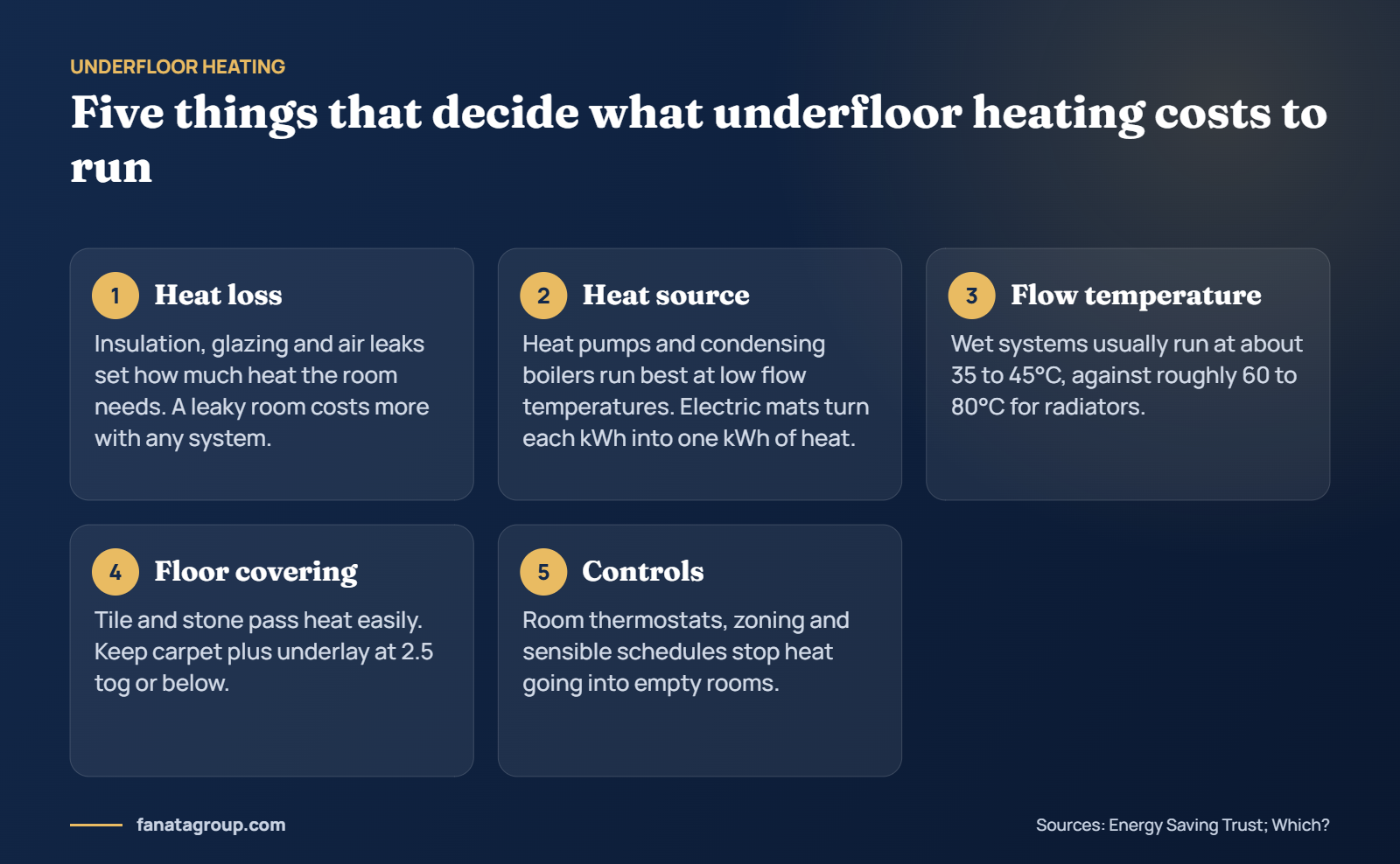
Controls and How You Use the System
Wet underfloor heating, especially in a thick screed, responds slowly. It can take hours to warm up and keeps releasing heat after it switches off. That changes how the system should be used. Large swings, where the heating is turned off completely during the day and pushed hard in the evening, tend to waste energy and comfort. Many installers suggest steady operation with modest setback temperatures overnight or when the building is empty.
Zoning is the other big lever. With a thermostat in each room or zone, heat goes only where it is needed, so bedrooms can run cooler than living areas and unused rooms can stay at a background temperature. Smart thermostats add scheduling and remote control, but the saving comes from the zoning and sensible settings rather than the app. Our article on underfloor heating thermostats explains the main thermostat types and sensors.
Factors at a Glance
| Factor | Effect on running costs | What helps |
|---|---|---|
| Heat loss | Sets how much heat the room needs | Insulation, airtightness, better glazing |
| Heat source | Sets how much energy each unit of heat needs | Heat pump or condensing boiler for wet systems |
| Flow temperature | Lower temperature improves source efficiency | Design for about 35 to 45°C |
| Floor covering | High resistance forces higher temperatures | Tile, stone or approved wood, carpet at 2.5 tog or less |
| Controls | Poor control heats empty rooms | Room thermostats, zoning, steady schedules |
| System type | Electric has no efficiency gain | Electric for small rooms, wet for larger areas |
What Published Estimates Say
Because running costs depend so heavily on the building and on local energy prices, there is no universal figure. Some consumer organisations publish indicative ranges. Which?, for example, calculated from manufacturer estimates that a water underfloor heating system in a 10 square metre room in the United Kingdom would cost between £45 and £80 a year to run, with a more efficient boiler pushing the figure toward the lower end. That estimate is specific to UK homes and prices at the time of publication, so treat it as a sense of scale rather than a quote.
For a better estimate for your own project, ask the system designer for the heat loss calculation and the design flow temperature, then combine them with the expected efficiency of your heat source and your local energy tariff. A good designer can also tell you how much output each room will get at the planned flow temperature, which shows whether the system can actually do its job efficiently. For installation budgets, which are a separate question, see our piece on underfloor heating prices.
Practical Ways to Lower Underfloor Heating Running Costs
Most of the savings come from decisions made before installation, although there are also habits that help once the system is running:
- Insulate under the heating layer and fix major heat losses in the building first.
- Choose a wet system for larger areas and keep electric mats for small, occasionally used rooms.
- Design for a low flow temperature and pair the system with a heat pump or condensing boiler.
- Pick floor finishes that conduct heat well and keep carpet plus underlay at 2.5 tog or below.
- Fit a thermostat in each room or zone and use modest setback temperatures rather than switching off completely.
- Balance the circuits after installation so every room gets the flow it was designed for.
- Service the heat source and check the manifold, pump and controls regularly.
Balancing deserves a special mention because it is so often skipped. When circuits are not balanced, short circuits near the manifold take more than their share of flow while long circuits run cold. Occupants then turn the temperature up for the whole house to fix one room, which raises costs everywhere. Our guide to the energy efficiency of underfloor heating covers more of these setup details.
Frequently Asked Questions
Is underfloor heating expensive to run?
It depends on the system and the building. Wet underfloor heating connected to a heat pump or condensing boiler in a well insulated space is usually cheaper to run than radiators, because it works at a lower flow temperature. Electric underfloor heating converts electricity directly into heat with no efficiency gain, so it tends to cost more per unit of heat and suits small or occasionally used rooms better.
What temperature should wet underfloor heating run at?
Most wet systems are designed for a water flow temperature of roughly 35 to 45°C, compared with around 60 to 80°C for traditional radiators. The exact figure comes from the heat loss calculation, pipe spacing and floor covering. Running at the lowest temperature that keeps rooms comfortable gives the best efficiency, especially with a heat pump.
Is it cheaper to leave underfloor heating on all the time?
For wet systems in thick screed, steady operation with modest setback temperatures is usually more efficient and comfortable than switching off completely and reheating from cold, because the floor responds slowly. That does not mean running every room at full temperature around the clock. Use room thermostats and schedules so that unused rooms and night periods run cooler.
Can I put carpet over underfloor heating?
Yes, as long as the carpet and underlay together have a low thermal resistance. The Energy Saving Trust cites a recommended combined rating of 2.5 tog or lower. Thicker carpets and underlays slow the heat down, which forces the system to run warmer and increases running costs.
Does underfloor heating work with a heat pump?
Yes, and it is one of the most efficient combinations. Heat pumps work best when they produce water at low temperatures, and underfloor heating is designed to heat rooms with exactly that kind of water. The system needs to be designed for the heat pump’s flow temperature from the start, with enough pipe and floor area to meet the room’s heat loss.
Conclusion
Underfloor heating running costs come down to a handful of decisions: how much heat the building loses, which heat source is used, the flow temperature, the floor finish and the quality of control. A wet system designed for a low flow temperature, laid on good insulation, finished with a conductive floor and paired with a heat pump or condensing boiler can be very economical. An electric system in a large, poorly insulated space can be the opposite. Ask your designer for the heat loss figures and design temperatures before you buy, and you will know what to expect on the bill. For more guides on heating, building systems and components, browse the Fanata Group topics page.
Reviewed by Fanata Group Editorial Team. Last updated November 29, 2026.